Project Brief
Turning manual API mapping into a clearer product workflow.
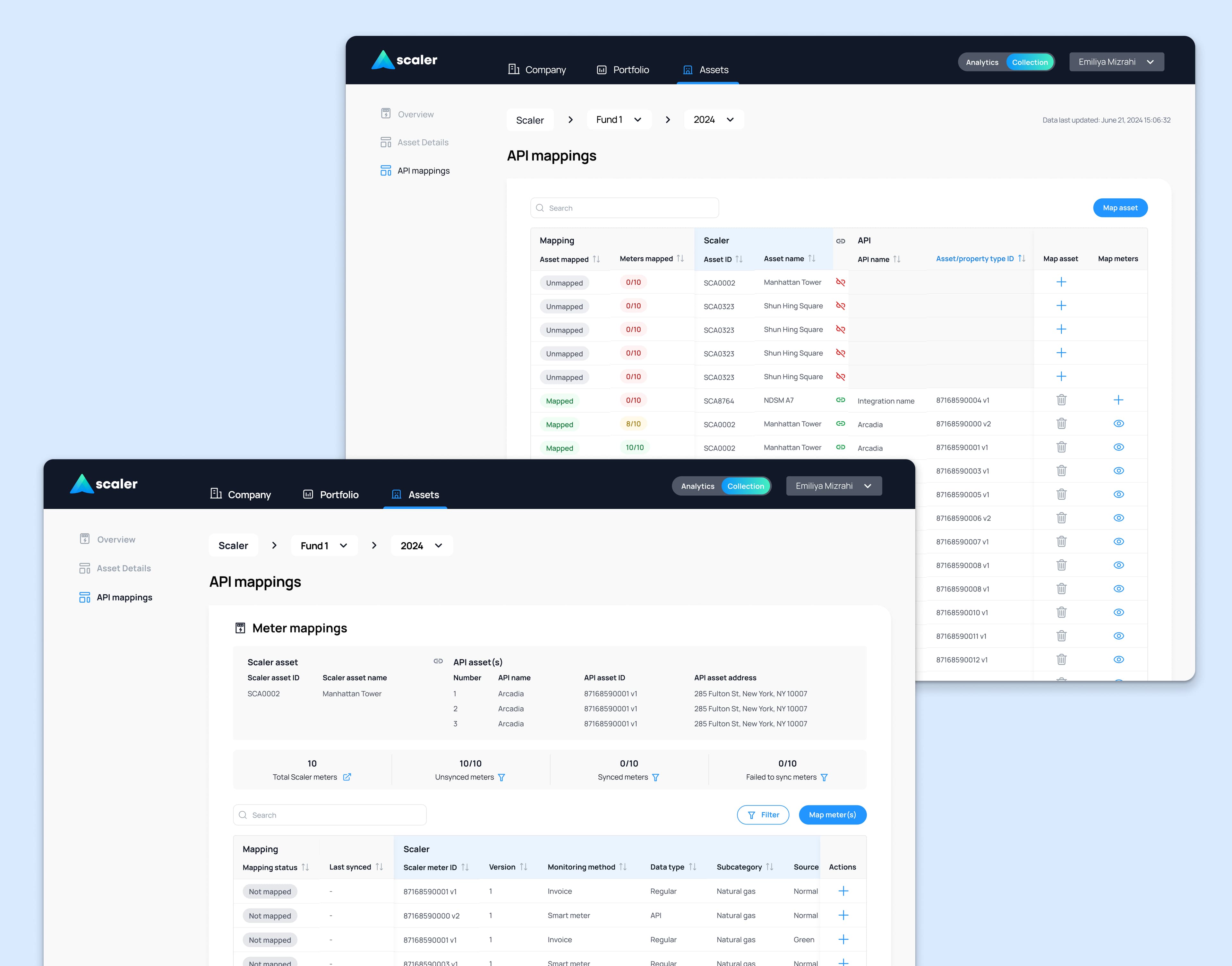
Designing a scalable workflow for mapping API-ingested sustainability data to the correct assets and meters.
Product Design
UX Research
B2B SaaS
Complex Tables
Multi-step Workflows
UXQA
Role
UX/UI Design, Product Design, UXQA
Team
Product Manager, Engineering Manager, Developers
Company
Scaler, an ESG data platform for real estate teams
Problem Space
API ingestion still relied on manual mapping.
After API keys were configured, customer success teams still relied on spreadsheets and back-and-forth communication to connect supplier data to the correct Scaler assets and meters.
This slowed implementation, increased internal effort, and created room for data quality issues in a product where accurate sustainability reporting is critical.
Project Goals
Create a scalable mapping workflow for API-ingested data.
01 Visibility
Show what is mapped, unmapped, or needs attention.
02 Mapping Flow
Help users connect API records to Scaler assets and meters.
03 Efficiency
Reduce manual work for customer success and engineering teams.
04 Data Quality
Improve confidence in integration accuracy and reporting.
Iterative Design
Simplifying a dense data workflow through progressive iteration.
The overview page evolved from a nested table into a clearer system of statuses, parent headers, and focused mapping actions.
V1
Nested table structure
Explored a nested table to show asset and meter relationships in one place.
V2
Separated mapping views
Separated asset and meter mapping to reduce hierarchy confusion.
V3
Clearer status visibility
Prioritized statuses, parent headers, and clearer mapping actions.
Emergent Feature Needs
Adapting the workflow when testing revealed unnecessary repetition.
Mid-development, testing surfaced an important concern: mapping meters one by one created unnecessary repetition for users managing larger data sets.
Concern
During testing, the main engineer raised an earlier concern about the repetitiveness of meter mapping.
Tradeoff
The team initially chose a one-to-one mapping approach to move quickly, but it became clear that the user experience would suffer.
Solution
I created a bulk meter mapping solution and worked with product and engineering to estimate, prioritize, and fit it into the release.
Release Strategy & Feedback
Validating the workflow through a staged release.
The feature was planned as a limited release across multiple stages, beginning with customers who were already familiar with API flows and had dedicated team members managing consumption data.
Measuring Success
01
Number of automated meters increases at a sharper rate.
02
Customer success help tickets related to API mappings decrease.
03
Qualitative feedback is documented, prioritized, and followed up through interviews.